
The Execution Gap Starts Earlier Than We Think
Jul 15, 2026
During a recent exchange in the Strategic Execution Network community, I was encouraged to write down an observation that has stayed with me throughout many years of working on transformation programs.
It isn't something I arrived at through research or a formal methodology. It's simply a pattern I've seen often enough that I can no longer ignore it.
Over the years, I've been involved in transformation programs across a range of industries and organizational contexts. The programs themselves were very different, each with its own objectives, constraints and stakeholders.
Yet looking back, I keep coming back to the same conclusion.
Organizations rarely struggle because the strategy itself is poor.
More often, they struggle because different parts of the organization gradually begin making decisions based on different interpretations of the same strategy.
At first glance, that sounds like a communication problem. I don't think it is.
Communication is usually happening throughout the organization.
Strategy is communicated through leadership meetings, organizational communications and governance forums. Teams understand what they're trying to achieve.
The challenge begins somewhere else.
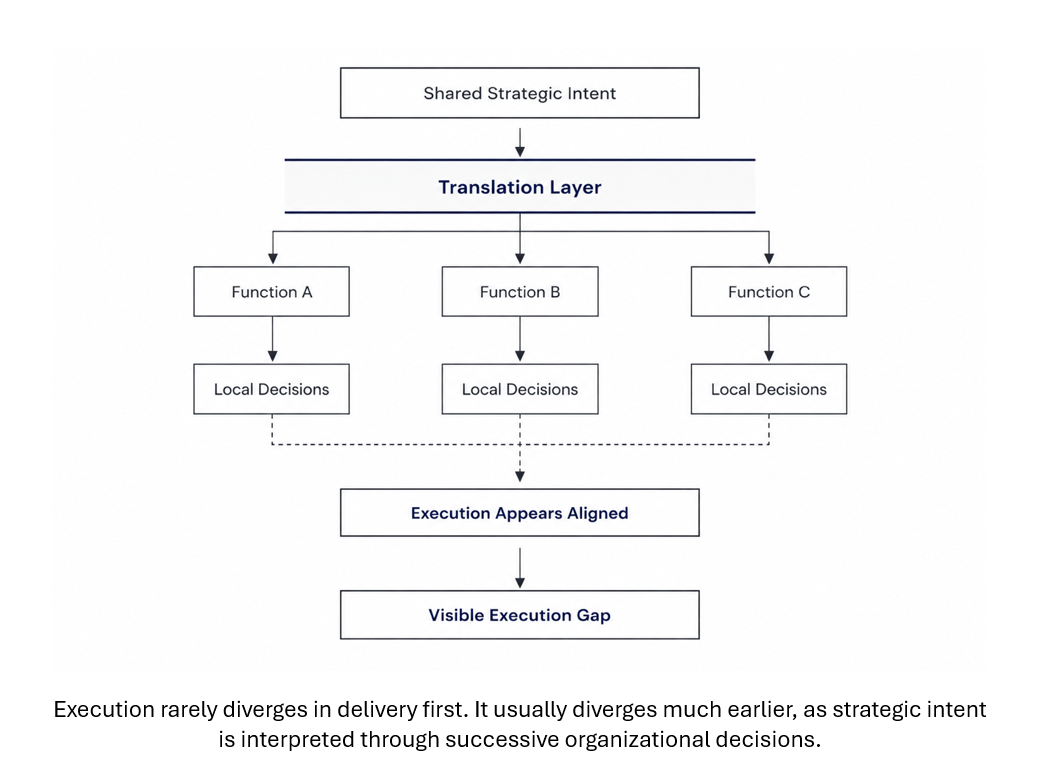
It begins because strategic intent rarely passes through an organization unchanged.
Once it leaves the boardroom, it starts being translated.
Each layer interprets it through its own responsibilities, priorities and constraints. None of those interpretations is unreasonable. In fact, each usually makes perfect sense from where that team sits.
Technology may interpret a strategic objective as platform modernization.
Operations may see the same objective as process simplification.
Risk may focus on strengthening controls.
Finance may emphasize efficiency and cost optimization.
Customer teams may interpret it through service experience.
None of them are wrong.
The difficulty is that each group is now making decisions based on a slightly different understanding of the same strategic intent.
No single decision creates a problem.
Collectively, those decisions begin pulling the organization in different directions.
That drift is remarkably difficult to see while it is happening because everyone remains committed to the strategy.
One experience has stayed with me because it fundamentally changed the way I think about governance.
During a Steering Committee meeting, the program team presented the completion status of several major deliverables. From the perspective of the delivery teams, the work had been completed. Progress was on track and the reporting reflected that.
An assurance representative then asked a simple question.
"Have these deliverables fully addressed the intended outcome? In other words, are they actually executable in the way the program intended?"
The delivery team answered confidently that they had.
Yet after the Steering Committee, many of those same deliverables were reopened within the assurance forums and were no longer considered complete.
At first, it appeared to be a disagreement about quality.
Looking back, I don't think it was.
Both groups were acting professionally and both were working towards the success of the program.
The difference was that they were working from different definitions of what "complete" meant.
For the delivery teams, completion meant the agreed activities had been performed and the required outputs had been produced.
For assurance, completion meant those outputs had demonstrably achieved the intended outcome and could be relied upon in practice.
Neither perspective was unreasonable.
The interesting part was that everyone sitting around the Steering Committee table believed they were discussing the same thing.
They weren't.
They were using the same language, but no longer attaching the same meaning to it.
The Steering Committee saw a program that appeared to be progressing as planned.
Meanwhile, the assurance forums continued reopening issues because, from their perspective, the strategic intent behind those deliverables had not yet been fully realized.
That experience has remained with me because it wasn't a failure of governance.
Governance was functioning exactly as designed.
What had quietly diverged was the shared interpretation of what success looked like.
Since then, I've noticed similar patterns in other programs.
Governance meetings are well attended.
Risks are reviewed.
Milestones are achieved.
Program dashboards remain largely green.
Nothing about the governance process appears fundamentally broken.
Yet the conversations gradually become harder.
Discussions that once took fifteen minutes now take an hour.
Simple decisions require multiple workshops.
Teams spend increasing amounts of time explaining their thinking to one another.
At the time, it often feels like delivery has become more complicated.
Looking back, I think something else was happening.
The meetings weren't becoming more difficult because people had stopped collaborating.
They were becoming more difficult because participants were unknowingly trying to reconcile different interpretations of what success looked like.
Another pattern I've noticed is that escalation tends to increase even when communication improves.
The instinctive response is usually to improve coordination.
More meetings.
More reporting.
More governance.
More communication.
Sometimes that helps.
But sometimes the organization isn't suffering from a lack of communication.
It's suffering from a lack of shared interpretation.
People are communicating frequently.
They're simply communicating from different assumptions.
That distinction has changed the way I think about governance.
For much of my career, I thought governance existed primarily to approve strategy and oversee execution.
Increasingly, I think it has another responsibility.
To continually test whether the organization is still making decisions based on the same strategic intent.
That feels like a very different governance question.
One asks whether programs are progressing.
The other asks whether the organization is still moving in the same direction.
The difference matters.
An organization can execute exceptionally well against multiple interpretations of the strategy.
From the perspective of each team, every decision may be entirely reasonable.
Viewed collectively, however, those reasonable decisions can slowly reduce organizational coherence.
Nobody intended to change the strategy.
Nobody consciously departed from it.
The organization simply accumulated enough local interpretations that execution gradually became fragmented.
Perhaps the earliest execution gap isn't between strategy and delivery.
Perhaps it's between a strategy that was agreed and a strategy that is still understood in the same way by everyone responsible for executing it.
By the time those two diverge, governance is no longer preventing execution drift.
It is simply reporting its consequences.
Article by: Marcus Pek | Director, Programme Management Office
Want More Strategic Insights?
Stop bridging the strategy-execution gap alone. Join the Strategic Execution Network — free monthly masterclasses, proven tools, and a mastermind of corporate leaders who've already solved what you're facing. It's free, it's practical, and business leaders are already inside.