
When Strategy Wins the Boardroom but Loses the Organization
Jul 20, 2026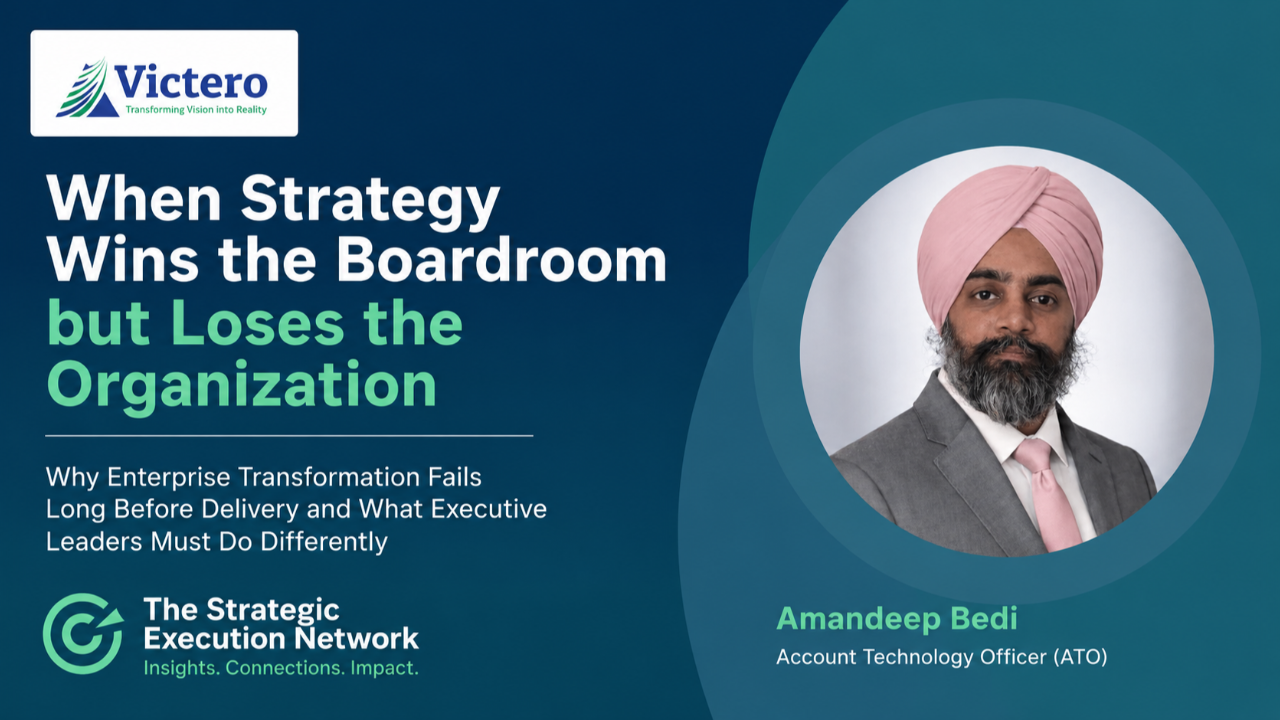
Why Enterprise Transformation Fails Long Before Delivery and What Executive Leaders Must Do Differently
Every major transformation begins the same way.
A compelling strategy is presented. The investment case is approved. Leadership is aligned. Governance is established, and delivery begins with confidence.
Yet months—or sometimes years—later, executive teams confront an uncomfortable reality: the organization has delivered programs, implemented technology, and consumed significant investment, but the business outcomes remain elusive.
This is often described as an execution problem.
In my experience, it rarely is.
The challenge begins much earlier.
The moment strategy leaves the executive table, it starts to change.
The Inevitable Drift of Strategic Intent
Organizations rarely abandon strategy. They gradually reinterpret it.
As strategic intent moves through portfolio management, governance, architecture, delivery, operations, and business functions, each layer makes rational decisions based on its own objectives, constraints, and incentives.
No individual decision is inherently wrong.
Collectively, however, they introduce what I describe as Strategic Drift—the gradual erosion of the original business intent through successive layers of organizational decision-making.
This is not a governance failure.
It is an organizational reality.
The larger and more complex the enterprise, the greater the distance between strategic ambition and operational execution.
Without deliberate intervention, that distance continues to grow.
Success at Every Level Can Still Produce Failure at the Enterprise Level
One of the most persistent misconceptions in enterprise transformation is that successful delivery naturally leads to successful outcomes.
It does not.
- Projects can be delivered on schedule.
- Budgets can remain within tolerance.
- Technology can meet every functional requirement.
- Governance can report green across every dashboard.
- Yet the enterprise may still fail to realize the strategic value that justified the investment.
- The reason is straightforward.
- Organizations often optimize for local success rather than enterprise outcomes.
- Delivery teams optimize for milestones.
- Technology teams optimize for architecture.
- Finance optimizes for cost.
- Operations optimize for stability.
- Business units optimize for their immediate priorities.
- Every function succeeds.
- The enterprise underperforms.
This paradox explains why transformation initiatives frequently appear operationally successful while strategically disappointing.
The Metrics That Matter Have Changed
Executive dashboards have become increasingly sophisticated.
They measure delivery velocity, budget consumption, program health, resource allocation, and implementation progress with remarkable precision.
These metrics remain important.
But they answer only one question:
Are we executing the plan?
The more consequential question is different.
Are our decisions increasing the probability of achieving the strategic outcome we originally intended?
That distinction changes the executive conversation.
Enterprise transformation should not be evaluated solely by the efficiency of delivery.
It should be evaluated by the preservation of strategic intent.
The organizations creating lasting competitive advantage are not those delivering projects more efficiently.
They are those ensuring that every investment decision continues to reinforce the business outcomes that matter most.
Alignment Is Not Governance. It Is Leadership.
Many organizations assume alignment is achieved through governance structures, steering committees, or program reviews.
These mechanisms are necessary.
They are not sufficient.
Alignment is an executive discipline.
It requires leadership teams to continuously reconnect operational decisions with strategic purpose.
That discipline begins with a small set of questions that deserve to be revisited throughout every transformation—not just at its inception.
- Are we still solving the business problem that justified this investment?
- Has our understanding of success evolved?
- Do current priorities reinforce or dilute our strategic intent?
- Are we measuring business outcomes or merely delivery performance?
- What have we learned that should influence our next decision?
These are not operational questions.
They are leadership questions.
The Emerging Responsibility of Technology Leadership
The role of today's CIO and CTO extends well beyond technology delivery.
Modern technology leaders are expected to translate enterprise strategy into measurable business outcomes while navigating increasing organizational complexity.
That responsibility demands more than technical excellence.
It requires preserving clarity as strategy moves across functions, portfolios, and delivery teams.
Technology has become accessible.
Delivery methodologies have matured.
Cloud platforms, artificial intelligence, and automation continue to accelerate capability.
What remains difficult is ensuring that these capabilities remain connected to the business outcomes they were intended to achieve.
That challenge cannot be delegated.
It belongs to executive leadership.
A Final Reflection
Organizations do not lose transformation because they lack capable people or effective technology.
More often, they lose sight of the original purpose behind the investment.
Strategy does not disappear through a single poor decision.
It fades through hundreds of reasonable ones.
The most effective leaders recognize this reality.
They understand that enterprise transformation is not simply about executing programs—it is about preserving strategic intent from the boardroom to the front line.
In an era where technology is increasingly accessible, the defining capability of successful organizations will not be their ability to build faster or deploy more.
It will be their ability to ensure that every decision, at every level, continues to move the enterprise toward the outcome that mattered when the strategy was first conceived.
“Strategy may begin in the boardroom. Enterprise value is created only when its intent survives the journey.”
Article By: Amandeep Bedi | Account Technology Officer
Want More Strategic Insights?
Stop bridging the strategy-execution gap alone. Join the Strategic Execution Network — free monthly masterclasses, proven tools, and a mastermind of corporate leaders who've already solved what you're facing. It's free, it's practical, and business leaders are already inside.